The NeoPtolemos Calorimeter is a large-volume gamma-summing scintillator detector, purchased for the needs of CALIBRA’s nuclear astrophysics research program. It is a cylindrically shaped (14 inch×14 inch) NaI(Tl) detector, segmented in two parts, with a borehole of 32 mm diameter along its axis. Its absolute efficiency for a twofold gamma-cascade is better than 50%.



NEOPTOLEMOS Calorimeter

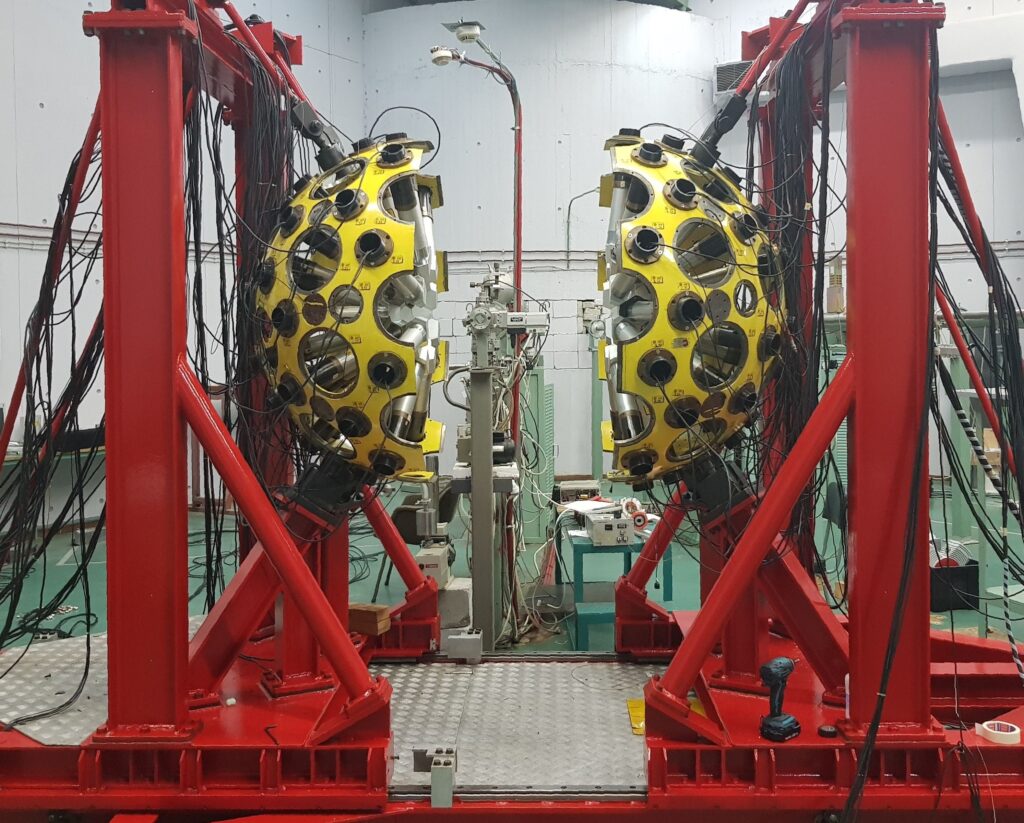
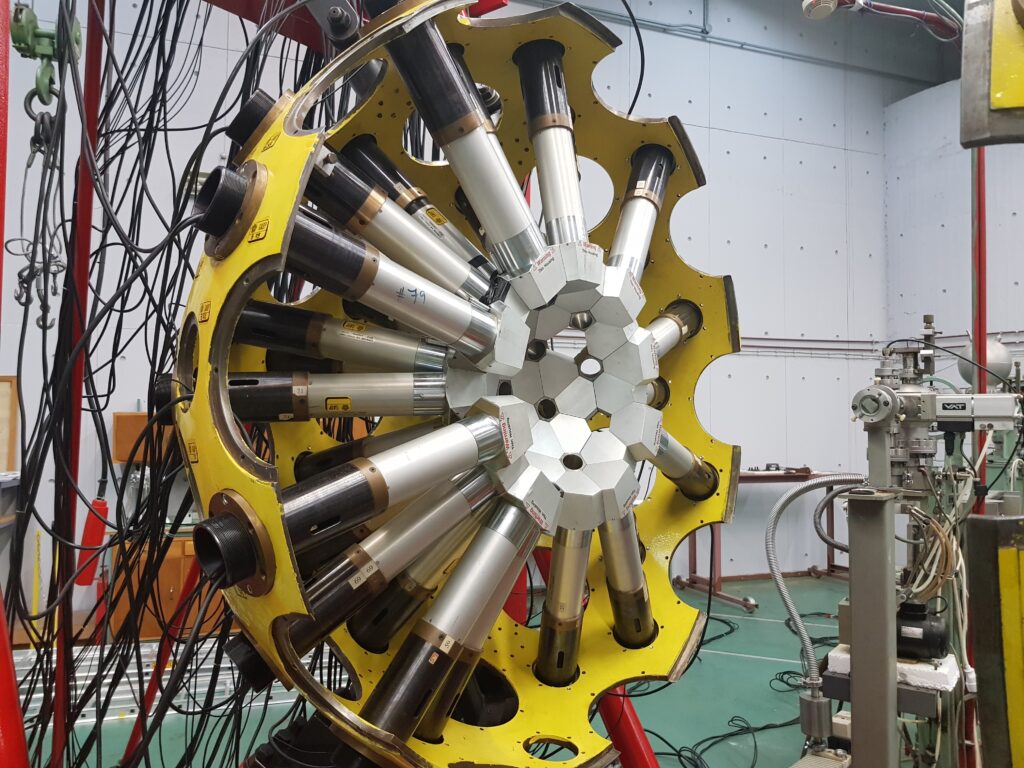
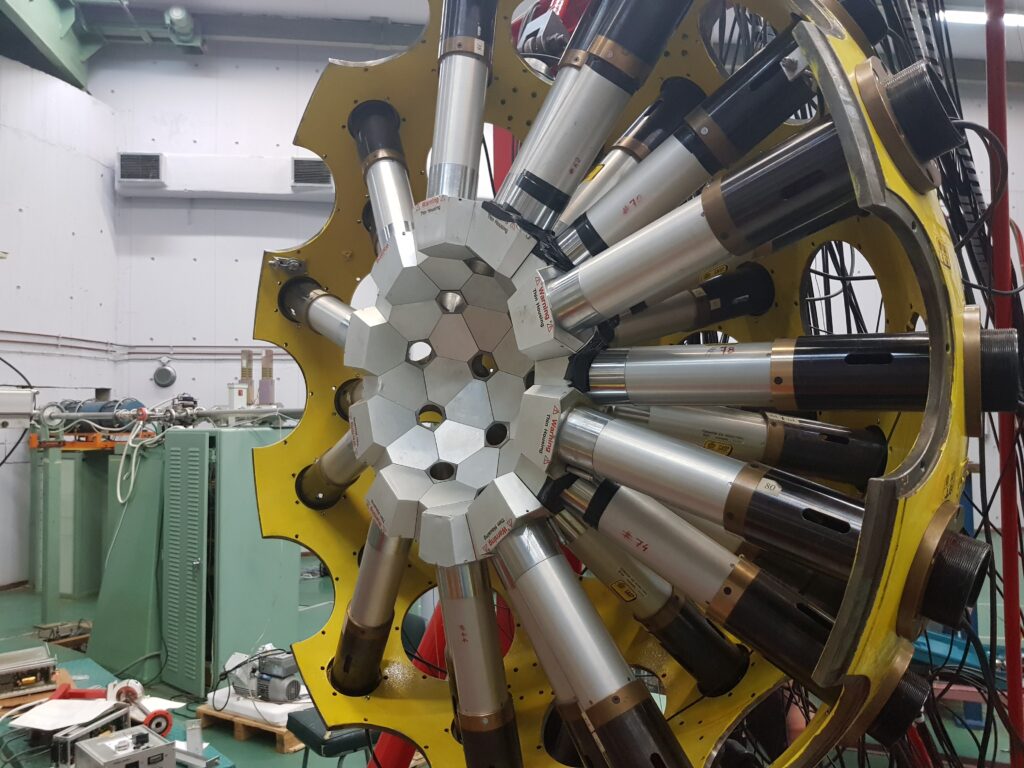
Pictures of the GASPAR BGO Ball. Each hemisphere contains 40 BGO crystals
NeoPtolemos is ideal for measuring nuclear reaction cross sections of radiative capture reactions. This is because it allows for measuring angle-integrated gamma-spectra instead of gamma-angular distributions. The latter method can be extremely time-demanding, especially when the cross section in consideration is very small, i.e., when the intensity of the gamma-rays emitted by the nucleus produced by the nuclear reaction are quite weak. In such cases, the use of highly efficient hyper-pure Germanium detectors (HPGe), even equipped with Anti-Compton shields (ACS), may not provide spectra with good statistics within a reasonable measurement time.
To overcome such problems, the Nuclear Astrophysics Group, of “Demokritos”, developed a new technique, known as 4π-gamma-summing, that is based on the use of a large-volume NaI(Tl) crystal detector with high absolute gamma-ray detection efficiency. Such a device sums, ideally, all gamma rays de-exciting the entry state of a compound nucleus and form gamma cascades. This summing feature practically allows to analyze only one single peak, called “sum peak” instead of numerous gamma transitions. Details on the working principle of such a 4π gamma-summing spectrometer, the new technique itself and a few examples of its application can be found in the review paper published in Eur. Phys. J. Plus (2021) 136:617 and in many references therein.