


Full-scale CALIBRA Research Infrastructure.

The full-scale CALIBRA Research Infrastructure foresees the establishment and operation of cluster of five accelerators grouped into three interacting laboratories, i.e., the Tandem Accelerator Laboratory (TAL), the Cyclotron Laboratory (CLab) and the Laboratory for Accelerator Mass Spectrometry (LAMS). These laboratories shall be equipped with state-of-the art setups and scientific instruments and share common auxiliary facilities and supporting workshops. LAMS shall form a joint facility with the X-ray Fluorescence laboratory (XRF Lab) already operating in the same building with TAL.

The proposed Full-Scale CALIBRA RI includes:

  • A new 6 MV Tandem accelerator to replace the existing 5.5 MV Tandem
  • The existing 250 keV single-stage accelerator PAPAP, that was donated by the Centre de Spectrometrie Nucleaire et de Spectrometrie de Masse (CSNSM), now renamed as “Centre de Sciences Nucléaires et de Sciences de la Matière”, Orsay, France
  • A 17 MeV Cyclotron for PET radioisotope production donated by the Dutch University Medical Center Groningen (UMCG), to be hosted in a brand-new building
  • A 1 MV accelerator for Accelerator Mass Spectrometry (AMS)
  • A 4 MV single-stage electrostatic accelerator with an ECR source.

In the initial Full-Scale CALIBRA proposal submitted in July 2013, a Time-of-Flight facility with a flight path of ≈40 meters for neutron irradiations, was also proposed to be built under the earth’s surface. Fast and moderated secondary neutrons will be produced using beams from the existing PAPAP accelerator and the 4MV single stage accelerator. The operation of such a facility has become almost mandatory as the only Greek Research Reactor is about to be decommissioned.

The proposed Full-Scale CALIBRA  RI is an all-encompassing accelerator-based research infrastructure to be developed around the existing Tandem Accelerator Laboratory (TAL) of NCSR “Demokritos”. The proposal for the full-scale CALIBRA RI submitted in 2013 foresaw an extension of the building hosting the Tandem accelerator. Due to the current urban planning regulations and building extensions applied to the campus of “Demokritos”, in combination with the CALIBRA’s downscaling, as a result of the drastic budget cuts that were imposed in 2017 by GSRI to all submitted infrastructure proposals, the initially proposed Tandem building expansion as described below may need to be revised. Nevertheless, the concept for a Full-Scale CALIBRA RI, remains the same.

According to the Full-Scale CALIBRA RI proposal, the space of the existing TANDEM lab needs to be expanded as indicated in figure 4. The necessary new “target rooms” are indicated in panel (b) of Fig. 4 with the letters A, B and C. Room A shall be built underground at the same level with the room indicated as “SF6 storage”. The room labeled “D” could be built on top of the roof (“attic”) of hall “A”.  The area C is required to host the AMS accelerator. The upper two panels (a) and (b) of figure 4 show models of the existing Tandem accelerator building. A bird view of the building is shown in (b). The non-colored areas labeled as “white”, “grey”, “green” and “red” rooms exist already. The “white” room corresponds to the area labeled as “SF6 storage” in panel (c). The length and width of the other existing target rooms are indicated by the numbers accompanying the relevant arrows. The heights are 6.2 m (“grey” room) and 6.7 m (“green” and “red” target rooms). The new “yellow” area should have height of at least 3.4 m, like the “white” one, whereas the “blue” and “olive” areas a height of approx. 4.5 m. The 250 keV PAPAP accelerator is installed at the “green” target room.
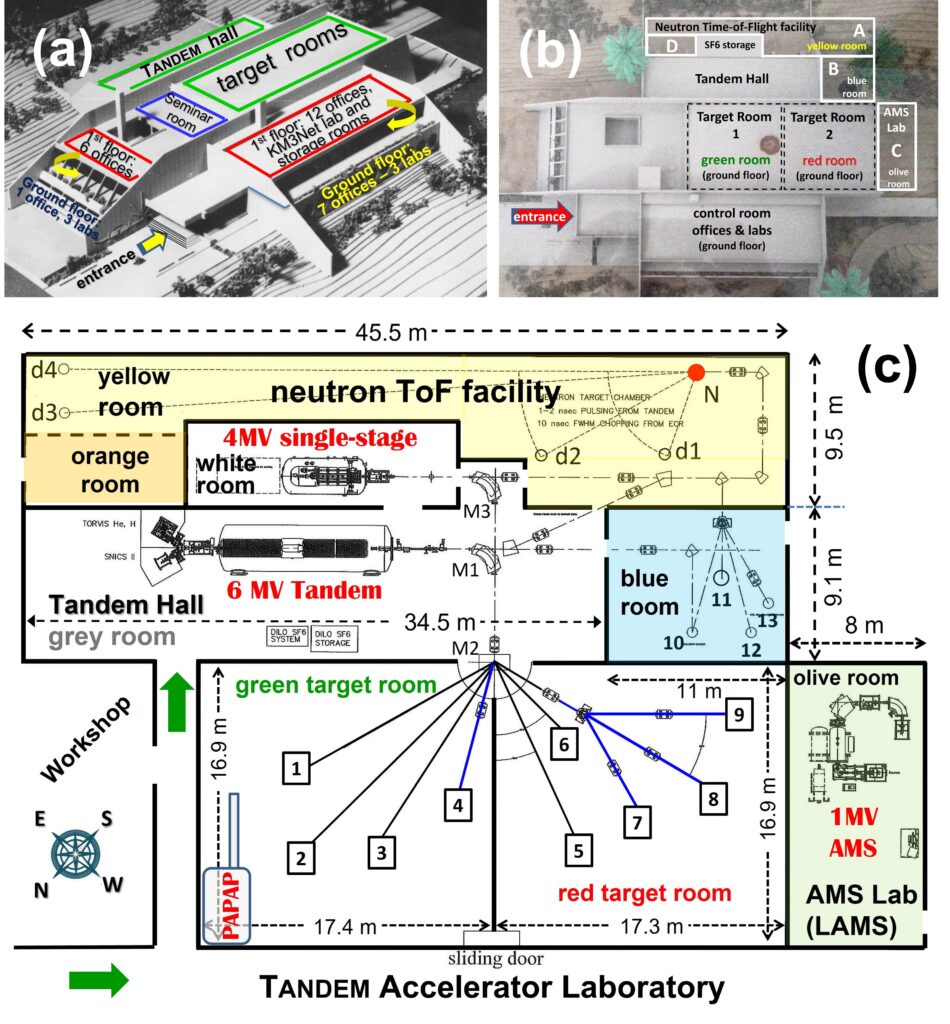
The envisaged layout of the Full-scale CALIBRA RI. The Cyclotron Laboratory is not included in this arrangement.

According to the layout in Fig. 4, the Full-Scale CALIBRA RI will be offering 12 beamlines in the “green”, “red” and “blue” target rooms, which are labeled with numbers from 1 to 12, as well as a dedicated target station for the production of neutrons, which is indicated with the letter N. The accelerated ions beams, from protons up to Gold, exiting the Tandem Hall (“grey” room) could be guided either to experimental setups installed at the existing “green” and “red” target rooms or to the new “blue” experimental area or to the neutron irradiation ToF facility (the new “yellow” room). In the first case, ions will be analyzed by the first 90-degree magnet (M1) and will be then switched by the switching magnet (M2) into one of the currently available beam-lines in the “green” or in the “red” target rooms. In order to increase the number of dedicated experimental setups, the existing beam line number “8” could split into three independent ones, i.e., a longer “8” and the two new beamlines “7” and “9”.

Light ion beams (up to Oxygen) produced by the Tandem accelerator could also be delivered to the “blue” experimental area using two quadrupoles operating after the M1 analyzing magnet and a subsequent 90-degree magnet with proper mass-energy product. These beams could be guided to any setup installed in beamlines “10”, “11” or “12”. These could be also accessible to heavy-ion beams (up to Ag) produced by the ECR source of the new 4 MV single-stage accelerator installed at the “white” room. In this way dual-beam irradiations will be feasible in the “blue” target room as well as high-current irradiations in the already existing “green” and “red” target areas.

A unique facility among those to be offered by CALIBRA is the neutron irradiation hall, labeled “yellow room” in Fig. 4. This hall is proposed to have a length of approx. 45.5 meters, so as to allow for Time-of-Flight measurements of neutrons with energies from 30 keV up to approx. 30 MeV produced by the nuclear reactions Li(p,n), T(p,n), D(d,n) or T(d,n). The targets for their production will be located at the point where the red solid circle labeled with the letter N. The necessary beams are delivered to the target position with a combination of focusing elements (steerers, quadrupoles, 90-deg magnets, etc.) either from the 4 MV Single-stage accelerator with high-intensities or from the Tandem accelerator. The beams can be either continuous or pulsed. The neutrons will irradiate samples located either very close (usually 10 cm) to the neutron production point, or at much longer distances, up to 40 meters. By combining such a long neutron flight path with 1 ns beam bunches from the Tandem, one expects a neutron energy resolution better than 30 keV for neutrons with energies of a few MeV. The “yellow” target room is designed to have a width around 9 meters so as to offer enough space for irradiations of large samples, also at a wide range of angles with respect to forward directed neutrons. The above listed neutron producing reactions provide primarily fast neutrons. For the need of irradiations with thermal neutrons, proper moderators could be also utilized.

With the accelerator arrangements shown in Fig. 4, it would be possible to run two experiments at the same time and on top of that to use completely independently the AMS accelerator in the “olive” area. Clearly, the proposed Full-Scale CALIBRA RI has the potential of offering a high number of beam-hours and serving a good number of users at the same time.

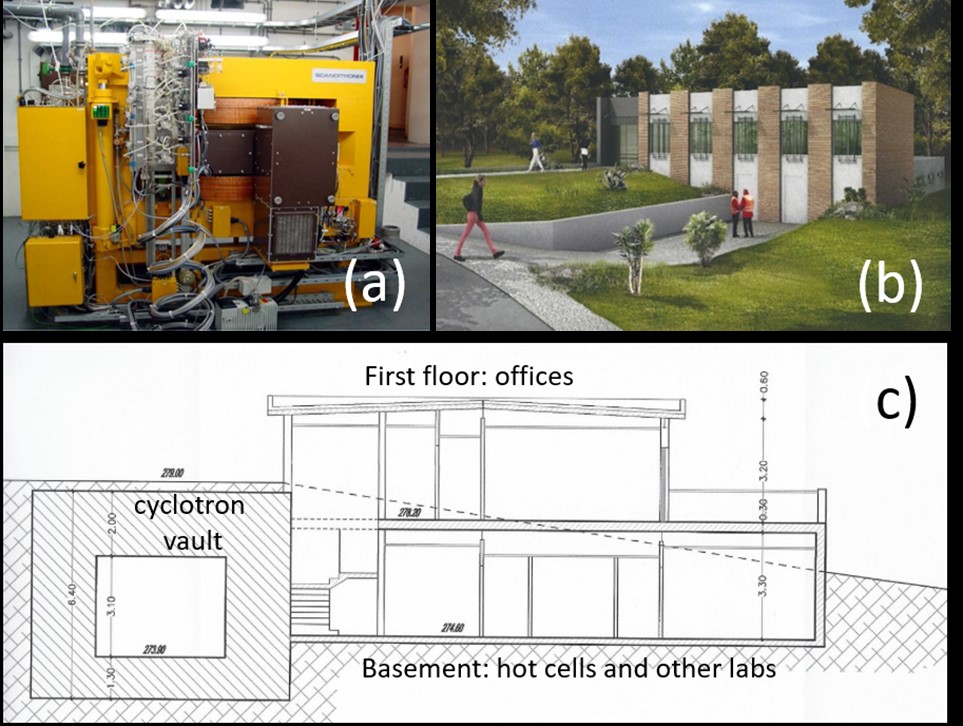
The PET Cyclotron lab is not included in figure 4. The CLab should ideally operate in a separate building, which is proposed to be built on a vacant building plot on the opposite side of the road leading to the main entrance of the Tandem accelerator building. A conceptual design of this building is shown in figure 5. It is based on a technical study prepared by an architectural company following the technical specifications, space requirements, radiation protection demands and security guidelines as well as and many other norms set by the International Atomic Energy Agency (IAEA) for PET-radioisotope-producing Cyclotron laboratories. The costs for the construction of this building were estimated as 0.8 million Euros. An extra budget of approx. 0.6 million Euros would be necessary for building’s basic equipment with electric power, water, pressurized air, air conditioning, negative pressure producing units etc.

The 17 MeV PET Cyclotron donated by Dutch University Medical Center Groningen (UMCG), is shown in panel (a). Based on the technical study delivered by an architectural company, the proposed new building will look as in panel (b). The building will include the cyclotron vault, as depicted in panel (c). Two levels are foreseen to host the hot cells and any relevant laboratory (basement) and the offices and other work rooms free of radioactive materials (first floor).