

The concept proposal to establish the CALIBRA Research Infrastructure (RI) was first submitted in February 2013 to the General Secretariat for Research and Technology, the Greek funding agency, which in 2020 was renamed to General Secretariat for Research and Innovation (GSRI). The concept proposal was submitted in response to the GSRI’s Call for Expression of Interest for the preparation of the Roadmap of National Research Infrastructures (NRI) and was largely based on ideas developed in the period 2008-2010, when two similar but more composite proposals were prepared and submitted for funding.
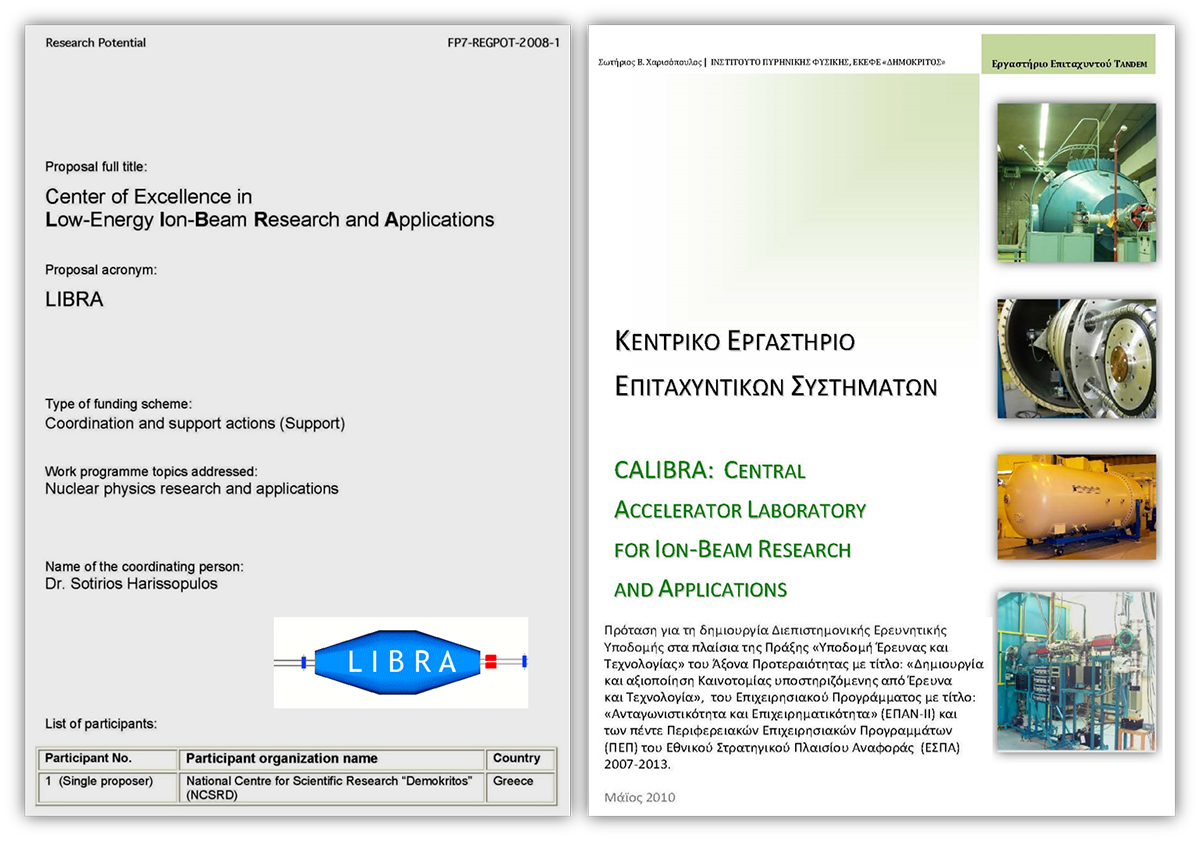
The first proposal entitled “Center of Excellence for Low-energy Ion-Beam Research and Applications”, abbreviated LIBRA, was submitted to the EC in 2008 as part of a competitive FP7/REGPOT funding program. LIBRA was evaluated by experts appointed by the EC, scored excellently (14.5/15) and was ranked eighth (8) among 474 competing proposals submitted under the call REGPOT/2008-1. The success of LIBRA led to a grant of ≈1.45 million Euros. Thanks to LIBRA, state-of-the-art scientific instruments were purchased and installed at the Tandem Accelerator Laboratory (TAL) and many accelerator components were upgraded. Through the collaborations of TAL with various European laboratories, which were reinforced thanks to the networking activities of LIBRA, many experimental setups and scientific instruments were donated or long-term loaned to TAL. These included a 250 keV single-stage accelerator named “Petit Accellerateur pour l’Astrophysique”, in short PAPAP, that was donated by the Centre de Spectrometrie Nucleaire et de Spectrometrie de Masse (CSNSM), now renamed as “Centre de Sciences Nucléaires et de Sciences de la Matière”, Orsay, France.
PAPAP was transferred to TAL with LIBRA funds and installed in 2011. PAPAP is capable of delivering proton and deuteron beams with intensities up to 1 mA. By December 2012, when LIBRA was completed, TAL’s infrastructure had been enriched with state-of-the-art instruments in excess of € 2 million Euros. One of LIBRA’s most important achievements, however, was the establishment of a User Group around the upgraded accelerator laboratory and the new facilities developed during the project.
The second infrastructure proposal, which provided many ideas and useful material for CALIBRA, and later for the drafting of its concept proposal, was prepared and submitted in May 2010 to the GSRT in response to its Call of March 2010, entitled “Research and Technology Infrastructure”, which was announced in the framework of the Operational Program “Competitiveness and Entrepreneurship” (ΕΠΑΝ-ΙΙ) under the Priority Axis entitled “Creation and exploitation of innovation with the support of Research and Technology”. These funding schemes belong to the so-called National Strategic Reference Framework (NSRF, in Greek ΕΣΠΑ) of the Programming Period 2007-2013.
The title of this proposal which was drafted in Greek (see figure 2) was having the English title “Central Accelerator Laboratories for Ion-Beam Research and Applications”. The resulting acronym is also CALIBRA! The funding request was 5,75 million Euros. The major part (4.55 M€) was for upgrades of the existing Tandem accelerator, the purchase of a new 3 MV single-stage ion beam accelerator equipped with an ECR source and the purchase of a new 1 MV Tandem accelerator for Accelerator Mass Spectrometry (AMS). The remaining 1,2 M€ were for the upgrade of supporting facilities, such as the mechanics workshop and the target preparation facility, as well as for the procurement of new scientific instruments.
Unfortunately, the aforementioned Priority Axis of the NSRF 2007-2013 was not implemented as originally planned by the GSRT, most likely due to the Greek economic crisis at that time. As a result, the evaluation process of all RI proposals submitted to the GSRT, including CALIBRA, has not even started. In addition, no initiative or even discussion on national research infrastructures was on the table until January 2013, when GSRI published its Call for Expression of Interest for the preparation of the Roadmap of National Research Infrastructures . The establishment of a National Roadmap for Research Infrastructures was a long-standing obligation (ex–ante conditionality) of Greece before the use of the European Structural and Regional Funds during the that time upcoming Programming Period 2014-2020.